

Jeninah Mary Ntabgoba
Details
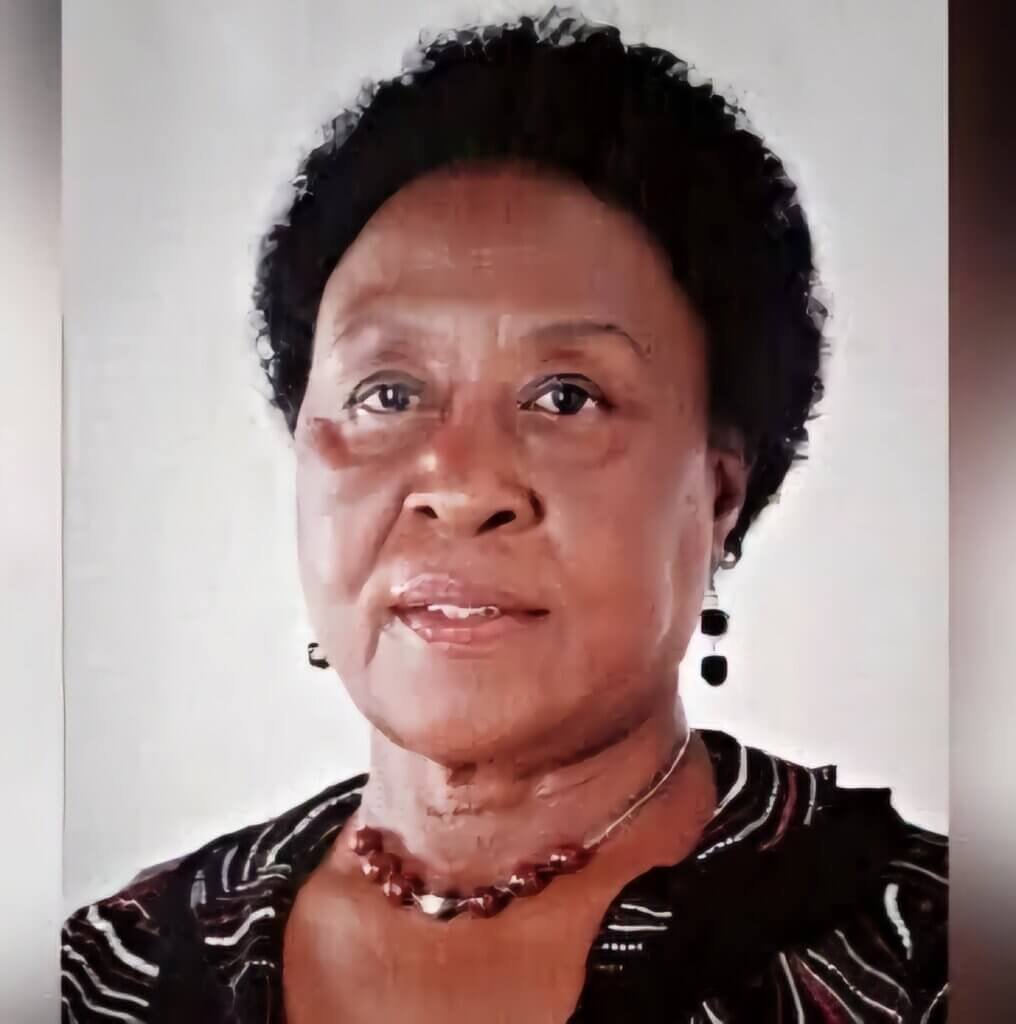
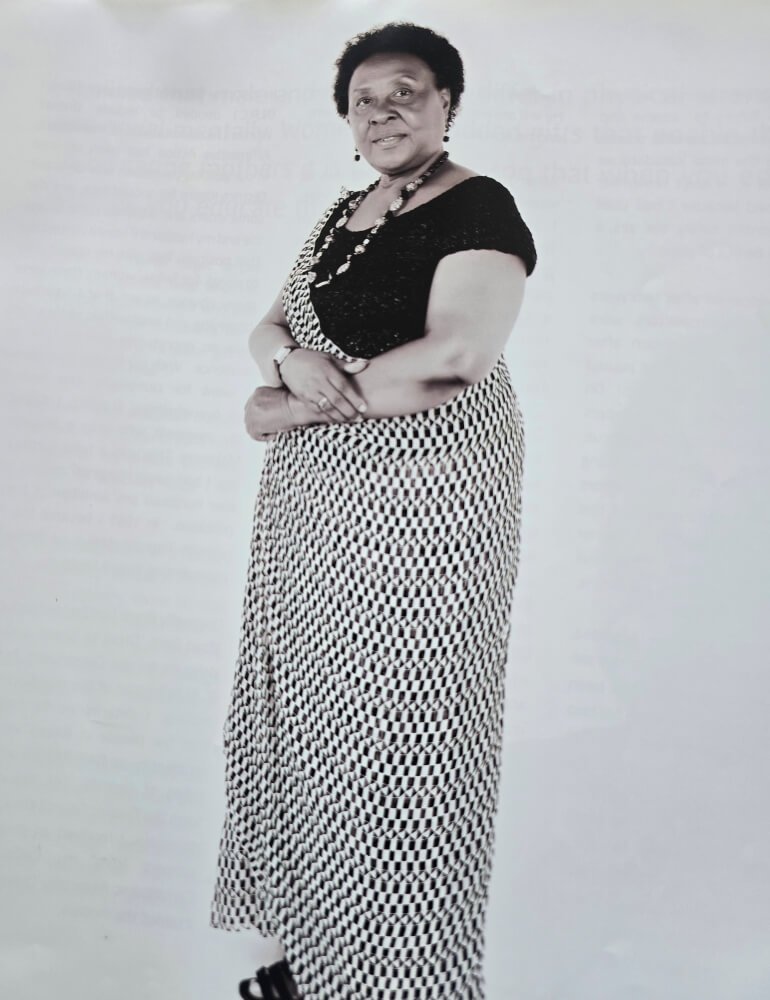
Jeninah Mary Ntabgoba (maiden name: Jeninah Mary Ndimubakunzi, also cited in literary and legislative records as Jeninah M. N. Ntabgoba) is a pioneering Ugandan legislator, educator, businesswoman, and children’s book author from Kisoro District. She made history as the first woman to represent Kisoro District in national politics, serving in the National Resistance Council (NRC), the 1994–1995 Constituent Assembly that drafted Uganda’s 1995 Constitution, and the 6th Parliament of Uganda, while also shaping early childhood literacy, model school teaching, and community development.
On Sunday, November 22nd 2026, I paid her a visit at their residential home, Bugolobi, and we together walked through her and her husband’s lives again. And this is a summary of her greatnesss.
Early Life and Education
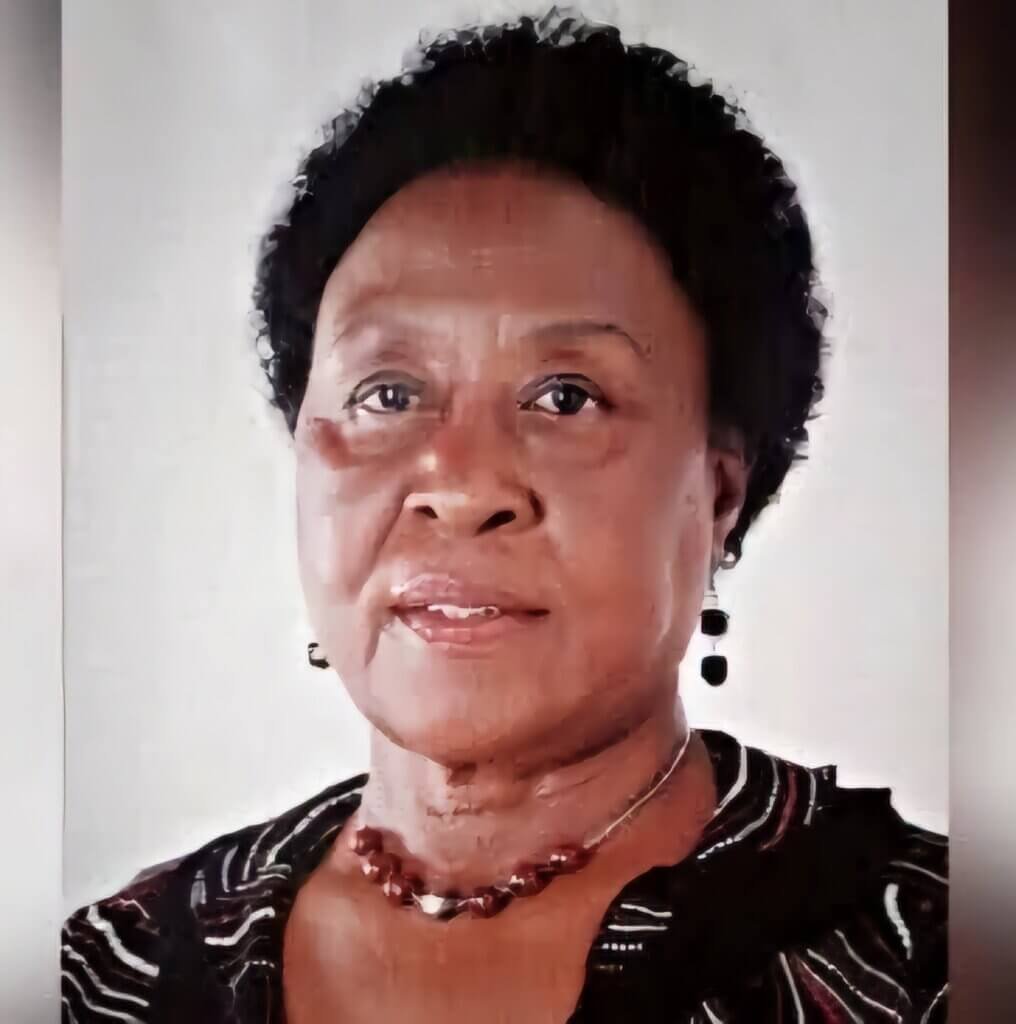
Jeninah Mary Ntabgoba was born in 1942 in Nyagashinge Village, Chahi (Kisoro Town Council), Kisoro District. As already noted, her maiden name is Jeninah Mary Ndimubakunzi. She was the last-born child of her father, Kazabatenda, a peasant farmer of the Abasigi b’Abasindi clan of Nyagashinge Village, and her mother, Maria Nyirabahizi, of the Abagesera clan from Sooko Parish, Nyarusiza.
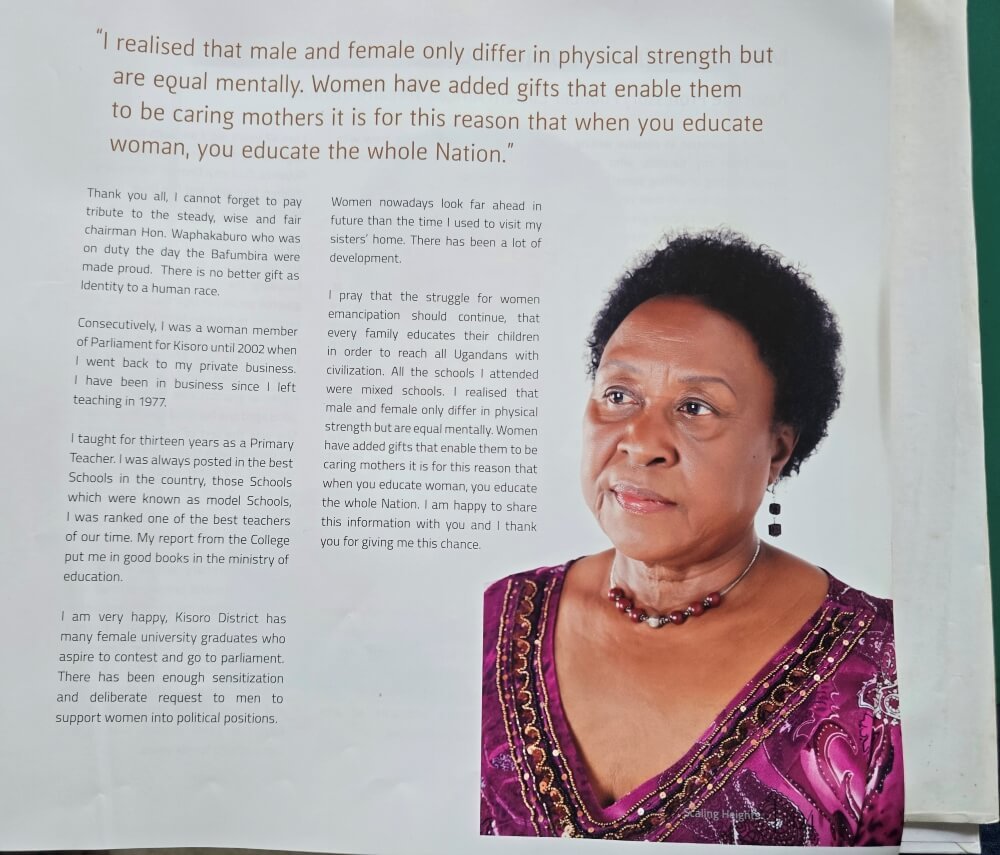
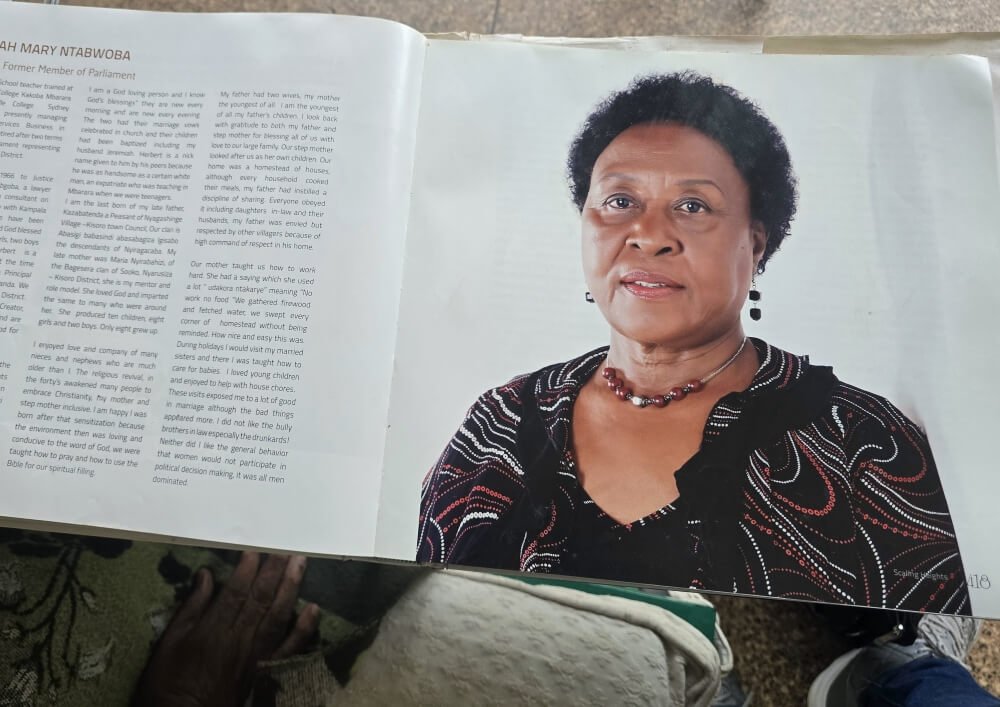
As documented in her autobiographical profile in Footmarks – Scaling Heights: Conversations with Women of Purpose in Uganda, an autobiography book on about 87 women, compiled by Gorretie B. Bamwanga, Jeninah grew up in a polygamous household where her father had two wives, her mother being the youngest, making her the youngest of all her father’s children and one of ten children born to her mother (eight girls and two boys), of whom eight survived. Today, she is the sole surviving sibling.
This autographical book, Footmarks, has been talked about and reviewed here, here, and here. Jeninah Ntabgoba has a copy too, and I took a snapshot.

According to the official magazine by the Ministry of Foreign Affairs, copies can be ordered through Ms. Maureen Komugisha; Email: Makmaureen@gmail.gmail.com; Tel: 0701251716.
Back to her story, Jeninah insists that her mother served as her foremost spiritual mentor and role model, raising the household in the spirit of the 1940s East African Christian Revival and instilling a lifelong work ethic summarized in her favorite Rukiga/Rufumbira proverb: “udakora ntakarye” (“No work, no food”).
Alongside her niece and age-mate Alice Nyiraguhirwa, whom Jeninah’s mother raised after Alice’s parents separated, Jeninah fetched water, gathered firewood, swept the compound, and visited her married sisters across various counties of Kisoro during school holidays, where she observed both the joys of family life and the harsh realities of women’s subordination.
As told in the Footmarks, witnessing how bright older sisters were confined to domestic roles while male relatives mocked girls’ education, with some brothers-in-law sneering that schooling would only turn a young girl into a malaya (prostitute) instead of fetching bride price, strengthened her resolve to earn an education before ever considering marriage.
This hit me hard. I have always believed that the hardships, missteps, and sacrifices that first-borns endure in families often serve as an inspirational push for last-borns, which is an unintended yet positive contribution that deserves recognition. In almost all families, especially those of the 1900s, it was often only the last-borns who truly made it, largely at the cost of their elder brothers and sisters. It’s my observation.
Education:
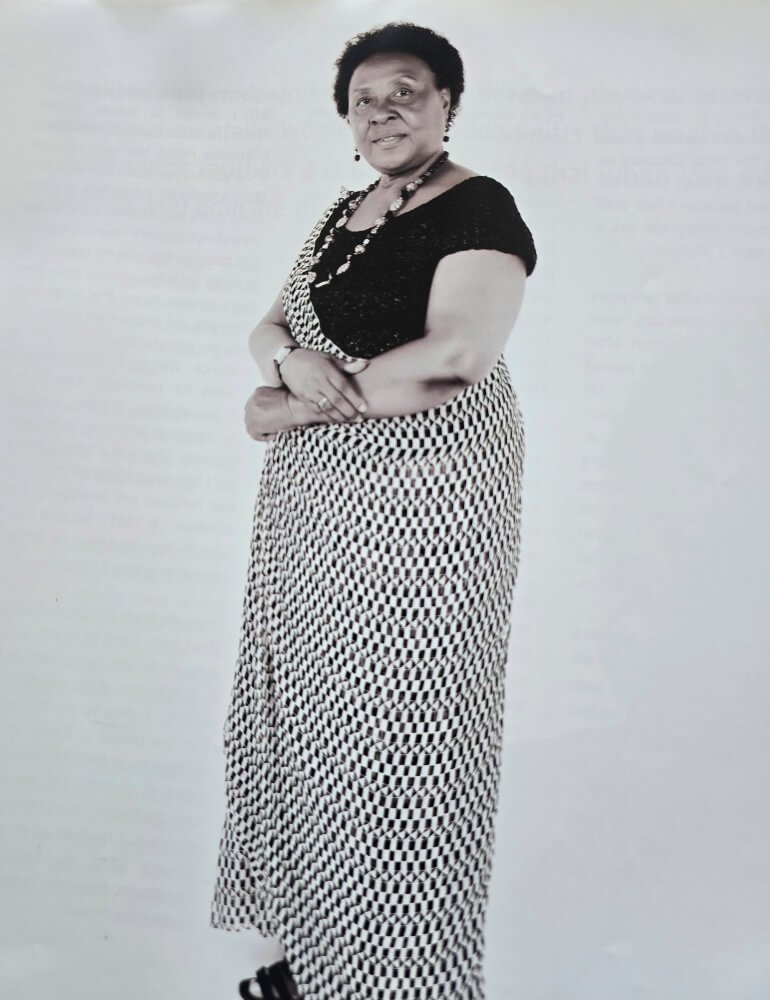
Jeninah attended Seseme Primary School in Kisoro, where she placed second in her school and earned a Grade One pass in the Primary Leaving Examinations. She was supported by her mother, who sold ubushera (sorghum beverage) in the market to raise school fees, and a Christian revivalist schoolteacher brother-in-law who paid her tuition from Primary Two through Primary Six.
According to her autobiography in Footmarks, in Primary Six, she made a personal commitment to Christian salvation, finding spiritual courage to stay focused on her studies.
She proceeded to Bishop Stuart College, Kakoba in Mbarara for secondary and teacher education, training at Kakoba Demonstration School before receiving Ministry of Education sponsorship to qualify as a Grade II Primary Teacher in 1960. She began teaching in 1961 at Hornby High School in Kabale (teaching Primary Five and later serving as acting headmistress for a year after expatriate headmistress Ms. Joan Hall departed under Africanisation).
What was Africanization? I did not ask her about this, but have Googled it myself! Google says it refers to the post-independence policies and cultural movements aimed at replacing colonial British and non-African dominance with indigenous Ugandan leadership, ownership, and identity.
Anna Adima at the Newlines Magazine insists that colonialists had not taken over every Ugandan industry like it was in Kenya. However, in my view, history shows that the colonial rule penetration into every fabric of Ugandans’ welfare was significant, necessitating the Africanization movement.
In 1963, she Jeninah travelled to Camdenville College in Sydney, Australia, on a Commonwealth Scholarship for a two-year specialized course in Infant Education, upgrading to a Grade III Teacher alongside thirty other Ugandan educators.
Career and Work
Jeninah Ntabgoba’s professional life spans four distinct arenas: classroom instruction and children’s literature, entrepreneurship, national lawmaking, and civic governance.
Returning from Australia in 1966, she briefly resumed teaching at Hornby High School before marrying and relocating to Kampala, where her husband worked in the Ministry of Justice. I asked her about her love with Justice Ntabgoba and how it all felt, and she confessed to me, ‘it was the best thing to happen to me. I have enjoyed my marriage, and Justice Ntabgoba has been a blessing in my life. I am forever grateful’ – paraphrased.
Across a 13-year teaching career, she was posted to premier “model schools” educating children from prominent families, teaching at Kitante Primary School and Shimoni Primary School in Kampala until retiring from classroom teaching in 1977 due to pregnancy-related health strain.
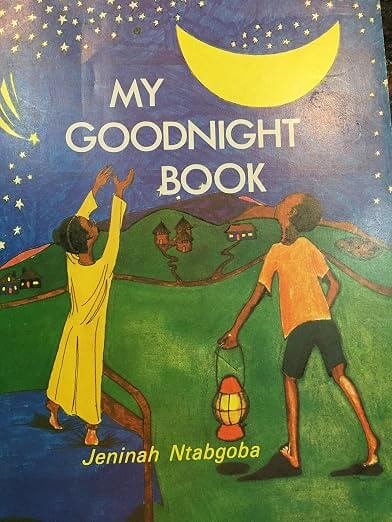
While teaching at Kitante Primary School, she authored two children’s books, that is, Listening is Fun and My Goodnight Book, both published by the East African Publishing House and later preserved in international collections, including the National Library of Australia (see here and here). I asked her about the physical copies of these books, and she said that one was lost, and the other must be somewhere in the house store. We did not have time and luxury of looking for it throughout the house.
Business:
Her transition into commerce began during Idi Amin’s economic war in the 1970s, when businesses formerly owned by expelled Asians were redistributed to Ugandans. Initially reluctant to attend allocation exercises, she accompanied colleagues from Kitante Primary School out of curiosity; upon arrival, an official singled her out, asked for her name, and allocated her a shoe shop from the Custodian Board on the spot. Very interesting.
According to her narrative in Footmarks – Scaling Heights, she initially manufactured and repaired shoes, handbags, and leather goods until import license suspensions cut off raw materials, prompting her to pivot into textile retailing, importing Benina sewing machines and hiring tailors to produce popular long dresses known as “Amin Nvako”, which boomed until fashion trends shifted after Amin’s fall.
Again, I have Googled the ‘Amin Nvaako’ line and found out that it was a kind of pushback clothing fashion against Amin’s decree regarding women’s wear. Apparently, Amin had banned (1972) women’s ‘mini-skirts and bell-bottom pants that were trendy fashions of the 1960s’. By 1974, he had even banned the use of wigs, trousers, and skirts with long slits. As such, women were forced to put on long dresses that they nicknamed, ‘Amin Nvaako’, in a way of saying, ‘I have put on what you asked; leave me alone’. In my deep search about this, I landed on some of the interesting bans or decrees by President Idi Amin on the Daily Monitor website, and to be sure I never miss these surprises, I have printed the page and uploaded it here for your download. Enjoy Amin’s decrees.
Back to Jeninah Ntabgoba, she later operated a grocery store on Dewinton Road in Kampala (which her niece managed while the Ntabgobas lived in exile). We will talk about this exile more when exploring her husband’s biography. Later, according to the ‘Footmarks‘, the original Asian owner reclaimed the Dewinton Road premises and large supermarkets rose up and reshaped grocery retail, prompting her to relocate to Bugolobi where she established and managed a Secretarial Services Business. She told me she no longer attends to this business on daily basis; she supervises it once in a while.
Life Abroad:
About the exile, during the turbulent early 1980s, as her husband rose from Registrar General and Administrator General to High Court Judge (and also top leadership position at ARIPO), political hostility and threats forced the family into a dramatic escape into exile. According to many testimonies, including ones from great lawyers, such as Tabaro Edgar and Alex Rezida, Justice Ntabgoba was tipped off by a friend in security that he was in danger after he had acquitted someone the Government of Obote II wanted detained. According to Mrs. Ntabgoba’s autobiography in the book, Footmarks, the family packed what little they could carry and abandoned most of their household property. She told me that one of the copies of her books got lost during some of these movements.
At Entebbe Airport, she narrates in her autobiography, operatives attempted to block them from boarding and pulled their luggage from the line, until Justice Ntabgoba stood his ground with his official invitation and Uganda’s ARIPO membership credentials to convince airport management to clear their departure. They got cleared.
They first settled in Nairobi, Kenya (1982). She told me they stayed in Kenya for a year. Later, they moved to Harare, Zimbabwe. The family spent seven years abroad with diplomatic status while Jeninah occasionally slipped back into Uganda to check on relatives in Kampala and Kisoro. We will explore more about Justice Ntabgoba’s work with ARIPO in his own biography.
Pioneering Kisoro Women Politics:
Upon returning home, Jeninah entered national politics when Kisoro elders and a local Bishop approached her and her husband in Kampala, urging her to contest the newly created District Woman Representative seat in the National Resistance Council (NRC) (elected in 1989/1990 and taking her parliamentary seat in 1991). Having never harbored political ambition, she accepted the call with her husband’s blessing, campaigned under the queuing voting system, won, and became Kisoro District’s first female legislator.
During our conversation, Jeninah Ntabgoba emphatically highlighted her husband’s support for her political crusades and struggles. In her own words, ‘Justice Ntabgoba, coming from the background of law, understood and cherished women empowerment. He was gender-sensitive, and always supported me in whatever endeavors I took on. He was very supportive…. I thank God who gave me a man like him. I learnt a lot from him, and he is hugely part of the reason I turned out the person I became. He hugely impacted my life.’
In May 1994, she defeated Joy Mateke to serve as Kisoro’s Constituent Assembly Delegate (CAD) (May 1994 – July 1995) during the drafting of the 1995 Constitution of Uganda, where, acting on a mandate from the Kisoro District Council and working alongside fellow delegates including the late Bagena, Ntacyotugira (probably, Philip Ntacyotugira), and Philemon Mateke, she tabled and secured overwhelming support for the constitutional recognition of the Bafumbira as an indigenous tribe of Uganda, a historic session chaired by Hon. James Wapakhabulo.
About Joy Mateke, Jeninah insists that she is one of the most intelligent, hardworking, and influential women she ever met. She categorically said, ‘I learnt politics and leadership from her. She mentored me. In fact, please, find time, meet her, and document her profile – she is one of the most influential women, even though she mostly served behind her husband and all other women she fronted’ – paraphrased. I will meet Joy Mateke and her husband soon.
By the 1995/1996 election campaigns for members of parliament, Jeninah was already versed with politics. As such, she contested on the ticket of Woman Member of Parliament for Kisoro District against Kwera Stella Ngirabakunzi, and won, and represented Kisoro in the 6th Parliament of Uganda (1996–2001/2002). Who is or was Kwera Stella Ngirabakunzi? I have no idea! I did not ask her. Jeninah, however, says Stella passed on some years ago! I Googled about Kwera Stella Ngirabakunzi, and the only thing I found about her was when she petitioned Jeninah Ntabgoba over the elections, a case she lost. I wish we had met before her death and documented her biography.
In the 7th parliament, Jeninah Ntabgoba lost the seat to Annette Mukabera. According to her, Mukabera deserved the win; she was young, highly educated, and empowered. In her own words, if someone had timely convinced me out of the race, I would have abstained from it. According to Jeninah, she celebrated Mukabera’s victory, viewing it as proof of women empowerment. She decided to retire and concentrate on her own life, family, and other passions.
In retirement, she has remained active in civic and educational governance, including serving as a Board Member / Trustee of Development Initiatives International (DII Uganda) and running her Bugolobi secretarial enterprise. She told me she enjoys having enough time to rest at home, celebrate her family, and oversea her business and the family’s estate.
Relationships and Family
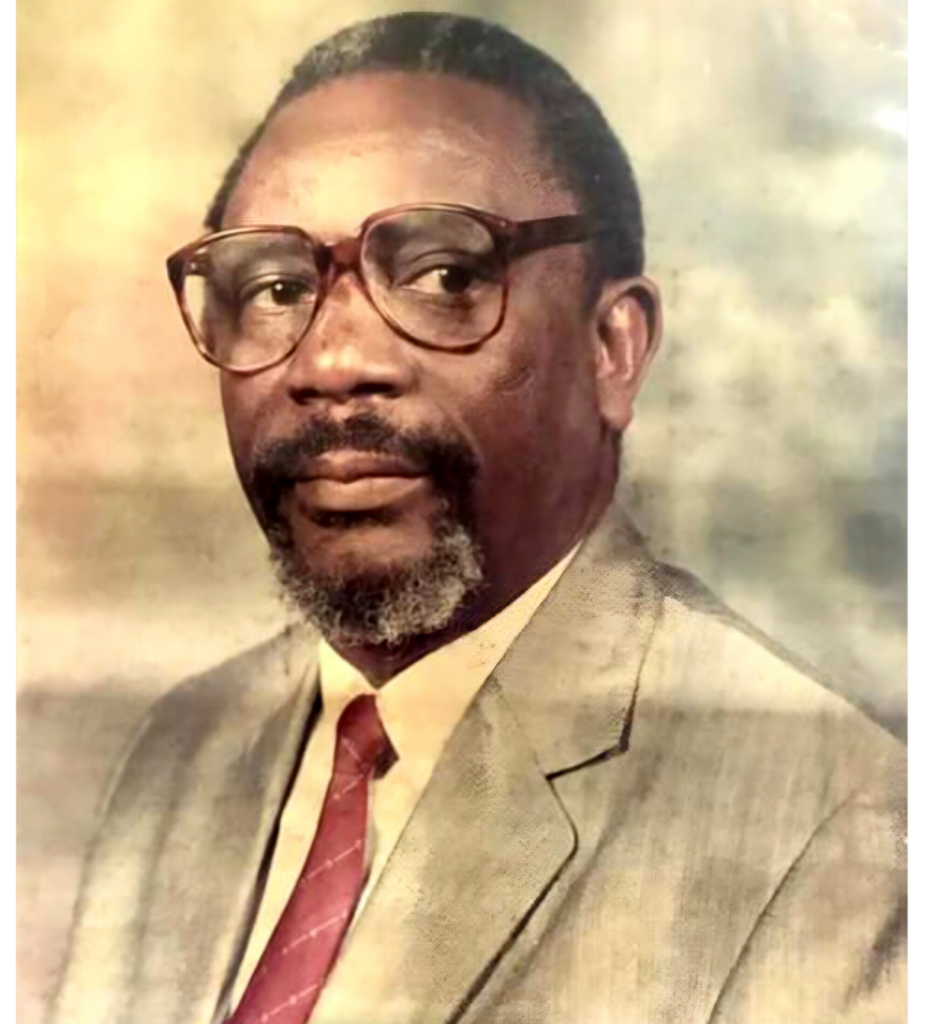
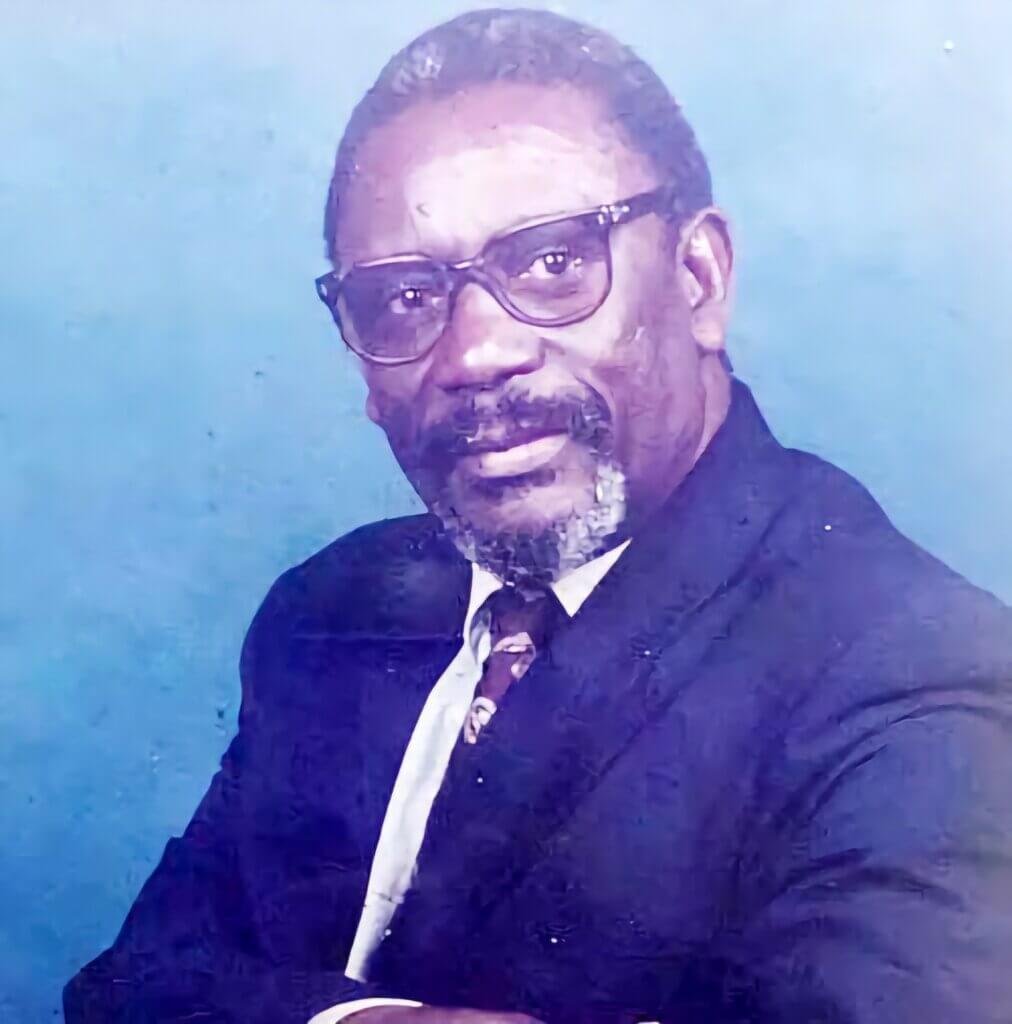
On December 28, 1966, she married Justice Jeremiah Herbert Ntabgoba of the Abacyaba (Umucyaba) clan, lineage of Nyirarucyaba, whom she noted in Footmarks earned the nickname “Herbert” from teenage peers in Mbarara because he resembled a handsome expatriate teacher. Together they built a partnership spanning over five decades until Justice Ntabgoba’s passing in April 2020, raising six children, four daughters and two sons (Jeffery, Judith, Jerome, Juliet, Justina, and Jeninah), and welcoming ten grandchildren. Each of the six children bears Ntabgoba’s name as the last name, for example, Jeffery Ntabgoba (see the naming here).
Grounded in shared Christian revivalist roots (both of their families embraced Christianity during the 1942 Kigezi revival), Jeninah frequently expressed gratitude that all six of their children grew into responsible, accomplished Ugandan citizens. Talking about their anchor in Christianity and the impact of revival in their lives, you will love the story she told me about the meaning of the name, ‘Ntabgoba’, detailed in Justice Jeremiah Herbert Ntabgoba’s biography.
Legacy: Achievements, Challenges, and Values
Hon. Jeninah Ntabgoba’s legacy rests on breaking educational, commercial, and political barriers for Bafumbira women while championing cultural identity and girls’ education. As Kisoro’s first woman in Parliament, she proved that women could command respect in national constitutional debates and constituency leadership.
Her early years in male-dominated parliamentary chambers were not without friction: in her landmark 1999 book When Hens Begin to Crow: Gender and Parliamentary Politics in Uganda, legal scholar Prof. Sylvia Tamale talks about Jeninah Ntabgoba and how she pulled her aside in a parliamentary hallway to express frustration over male MPs mocking issues affecting women and children: ‘After that session ended, a woman MP, Jeninah Ntabgoba, stopped me in the hallway and said, “You see how these men make fun of serious issues affecting women and children? I hope that you include this in your report.“‘ (see page 122 of this report). I asked Jeninah about this exact encounter with the researcher, and she said she could scarcely recall every single hallway conversation amidst the many advocates and scholars who sought her out as Kisoro’s pioneer female MP. And I truly agree with her.
Her lifetime of purpose and resilience was formally preserved in Footmarks – Scaling Heights: Conversations with Women of Purpose in Uganda, compiled by Gorretie B. Bamwanga (Mentors’ Team Africa), photographed by Flavia B. Luwero (The Face Studio), and designed by Ernest Mugabe (Spin Group).
Throughout her life, her philosophy has remained anchored in Christian faith, hard work, gratitude, and the conviction that educating women uplifts an entire nation. As she famously reflected in Footmarks: “I realised that male and female only differ in physical strength but are equal mentally. Women have added gifts that enable them to be caring mothers; it is for this reason that when you educate a woman, you educate the whole Nation”, a maxim paired with her enduring tribute to cultural heritage: “There is no better gift as identity to a human race”.
Author Info

Review
Login to Write Your ReviewThere are no reviews yet.
Leave a Review

-
Abasindi Clan: Ancestral Origin & Totem,…
November 25, 2026 -

7 Bafumbira Groups You Should Know…
November 3, 2026 -

Rufumbira Language for Bafumbira: Is Speaking…
October 2, 2026 -
President Museveni asks us to preserve…
September 30, 2026 -

Abungura Clan: Origin, Totem, Historical Roles…
September 22, 2026