

The Bafumbira Social Structure: Hutu, Tutsi, and Twa and the Bond they all Share!

Central to the Bafumbira identity is a tripartite social system consisting of the Hutu, Tutsi, and Twa. While 20th-century history, heavily influenced by Western colonial “racial science“, recast these groups as warring tribes, a deeper historical and sociological analysis reveals that they were, for 1,500 years, complementary social classes bound together by a shared language, shared spiritual belief, and an unbreakable clan system.
In this article, we will dig deeper into Bafumbira (and Banyarwanda) social classes of Hutu, Tutsi, and Twa, and the bond they all share.
NB: Of course, when we talk of Bafumbira, we are basically talking about Banyarwanda that later became Ugandans. We have covered these stories here and here.
I. Hutu, Tutsi, and Twa: The Origin
To understand the Bafumbira social structure, one must first establish the timeline of their presence in the Great Lakes region. Archaeological evidence of the Bantu Expansion suggests that agricultural and pastoralist communities settled the fertile Albertine Rift as early as 500 AD (the 5th Century).
While many Ugandan ethnic groups arrived during later migrations—such as the Baganda in the 13th century or the Luo in the 15th century—the ancestors of the Bafumbira have occupied the Virunga foothills for approximately 1,500 years. This “seniority of settlement” is the bedrock of their social bond. By the time the British and Germans negotiated the 1910 border that “captured” the Bafumbira within the Uganda Protectorate, these three groups had already perfected a symbiotic ecosystem.
But where did they come from?
Seriously, the overall origin of Banyarwanda or Bafumbira and their three social classes is a very confusing one. About four or five theories are suggested and none of them hits home 100%. However, in my view, some of these theories are too mysterious to believe. For example, according to Wikipedia’s article on Hutu, Tutsi, and Twa, one theory suggests that a guy named Kigwa fell from the sky! And where did Kigwa come from? Lisa Ndejuru has more stories to tell! In all of this, I surely do not see a Gen Z believing this!
Of course, some historians suggest that the Hutus and Tutsi arrived at different times from different places, both finding the native Twa already occupying the mountains and fertile soils. We covered these details in our detailed article on the origin of Bafumbira and their nativeness. Read it here. More recent theories are even more scientific, figuring out what each one of us is made of or tolerant to before they can judge where we possibly came from!
However, when all is done and said, one thing is historically clear – these three groups (the hutus, tutsis, and twas) somehow found a way of symbiotically living and working together. As one tribe and culture, they shared language, religious beliefs, geographical locations or neighborhoods, and even clans, the most ancient and ‘blood-soaked’ way of classification (we will come back to Bafumbira Clans in the next article).
In brief, literally speaking, they (Hutu, Tutsi, and Twa) were or are one people!

II. Hutu, Tutsi, and Twa: The meaning
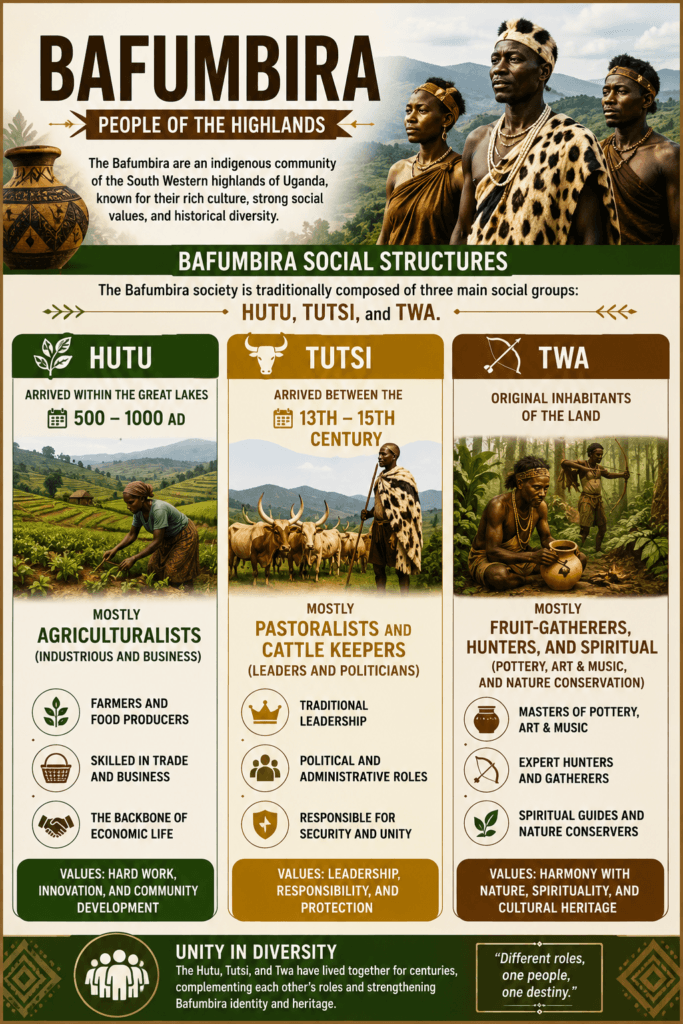
In the pre-colonial Bafumbira context, Tutsi, Hutu, and Twa were not ethnic or racial labels in the Western sense; they were specialized functional roles within a single civilization. They were social classes.
I have personally insisted that social stratifications are like natural to humans; people always classify themselves – the rich and the poor, the calm ones and the noise-makers, the good and the bad, the least developed and higly developed countries as classified even by the United Nations. This is human, and almost unavoidable. And, in most cases, it actually comes with prejudices, some forms of injustices, and inequalities.
As such, Banywarwanda or Bafumbira, just all other human beings, classified themselves as Bahutu, Batutsi, and Batwa. But what did they mean by these words, by these classes?
1. The Bahutu: Architects of the Landscape
The Bahutu were the master agriculturists of the volcanic highlands. They developed a sophisticated system of mountain terracing that prevented erosion on the steep slopes of Mount Muhabura, Mount Gahinga, and Mount Sabinyo. Their role was the production of the society’s caloric foundation—sorghum, beans, and millet. Historically, “Hutu” was a socio-economic label for a farmer.
In other words, the term ‘hutu’ was more about what one did or does and less about the personhood or the human qualities of a person. Many scholars support this view, including our own Edgar Tabaro here. You can also read here, here, here and here. There is also a big conversation about this on Reddit.
As a matter of fact, evidence shows that, because the society was meritocratic, a Hutu who demonstrated exceptional skill in agriculture could trade surplus produce for cattle, initiating the process of social elevation. In other words, one would cross over from being a hutu to, for example, a tutsi! We will come back to these concepts.
2. The Batutsi: Managers of the Capital
The Batutsi were traditionally pastoralists. In this society, cattle were the primary form of currency and a symbol of “capital.” The Tutsi role was centered on the management of these herds, statecraft, and military protection. They acted as the political administrators, but this power was not absolute; it was tied to the Ubuhaake system—a contract where cattle were leased to others in exchange for loyalty and labor. This created an interdependent economic web where the pastoralist and the farmer were partners in a mutual survival pact.
Just as it was for Bahutu, tutsis would also cross-over to hutu if they lost their cattle or capital or wealth. Again, we will come back to these ideas.
3. The Batwa: The Spiritual Guardians
The Batwa, often marginalized in modern discourse, were the original inhabitants of the high-altitude forests. They functioned as specialized artisans, hunters, and master potters. In the social hierarchy, they held a unique “outsider-insider” status. They were the musicians, entertainers, and elite guards for the local leadership. More importantly, they were the spiritual link to the ancient forests, providing medicinal herbs and honey that neither the farmer nor the cattle-keeper could access.
In other words, Hutu, Tutsi, and Twa were not ethnical or racial groups, but social stratifications based on the occupation and socioeconomic status.
III. The Fluidity of the “Social Elevator”
Well, I promised we would come back to the possibilities of crossing over from one social class to another, right? Here we go:
The most powerful evidence against the “ethnic” nature of these groups lies in the linguistic concepts of Kwitutura and Kwihutura. These terms describe the social mobility that was a hallmark of Bafumbira life for centuries.
Please, always note that where I say ‘Bafumbira’, I mean Banyarwanda as well. And where I say Banyarwanda, I likely mean ‘Bafumbira’ since we all understand this ‘confusion’. Back to the point:
- Kwitutura (To become Tutsi): When a Hutu farmer accumulated significant wealth in cattle and adopted the lifestyle and marriage circles of the pastoralists, they “shed” their Hutu status and were recognized as Tutsi.
- Kwihutura/Guhutura (To become Hutu): Conversely, if a Tutsi family lost their cattle through disease or war and were forced to survive by tilling the land with a hoe, they eventually descended into the Hutu class.
This fluidity proves that the Bafumbira social structure was a ladder, not a wall. One’s identity was determined by what they did for the community and how they managed their wealth, not merely the circumstances of their birth.
I have read many articles about this social mobility, but my best takes are this one, this one, and this one. Read for yourself.
In summary, If you took away the Hutu, the society would starve. If you took away the Tutsi, the society would lose its political organization and defense. If you took away the Twa, the society would lose its spiritual connection to the forest and its master craftsmanship. They were all important in their own ways and lived together.
IV. The Clan: The Invisible Bond
While Hutu, Tutsi, and Twa defined one’s social status (what you did for a living), the Clan (umuryango) defined one’s bloodline (who you were or are). This is the “Golden Thread” that bound the three groups together. Apparently, it is common to find batutsi, batwa, and bahutu belonging to one clan. In other words, they share similar ancestral bloodline. What does it mean? They are one!
What is a clan? We will have a detailed article on Bafumbira clans. However, for now, understand that clans are more ancient, historical, and more relevant than any social constructions. To understand them, you have to look at them as “Spiritual Nationalities” that existed long before the terms Hutu, Tutsi, or Twa were ever used.
In some oral tradition, each clan was founded by a legendary figure. These founders were usually the leaders of the original families that migrated into the Great Lakes region during the Bantu expansion (around 500 AD).
There are approximately 13 major clans among the Bafumbira, including the Abasinga, Abazigaba, and Abasindi. These clans are vertical, meaning they cut across social classes. Umusinga could be a Tutsi chief, a Hutu farmer, or a Twa potter. Very interesting!
Because clans were exogamous (one had to marry outside their clan), a Hutu-Muzigaba and a Tutsi-Muzigaba considered themselves “brothers” through their shared totem and ancestors. This shared “Ancestral Anatomy” made it impossible to view the other group as a separate “race” because they were part of the same spiritual family.
Like I said, we will come back to this in the next article.
V. The Colonial “Poison”: Breaking the Stool
The stability of this three-legged stool—Hutu, Tutsi, and Twa—was intentionally sabotaged by European colonial powers (primarily Germany and later Belgium, with British influence in the Kigezi region). Western powers brought with them the “Hamitic Hypothesis”—a pseudoscientific theory which argued that the Tutsi were a superior “Nilotic” race from Ethiopia, while the Hutu were an inferior “Bantu” peasantry.
The Weaponization of Identity
In the 1920s and 30s, the introduction of Ethnic Identity Cards and the “10-Cow Rule” effectively ended social mobility. I have read many articles on the ethnic identity cards and 10-cow rule and my best are this and this one.
10-Cow Rule: This concept, often cited in historical analyses of Rwanda, stated that any person owning ten or more cows was classified as a Tutsi, while those with fewer were classified as Hutu. This rule was used to help determine ethnic classification.
Ethnic Identity Cards: Introduced in 1933–34 during a population census, Belgian authorities issued, mandatory ID cards that categorized every Rwandan as Tutsi, Hutu, Twa, or Naturalized.
These two significant changes had serious consequences:
- Rigidity: Once a person was labeled “Hutu” or “Tutsi” on a government ID, the processes of Kwitutura and Kwihutura became illegal. Can you imagine this?
- Divide and Rule: By favoring the Tutsi as colonial proxies for administration, Westerners created a “privileged” versus “oppressed” dynamic where none had existed in such a rigid form before. This created rage and serious enemity among people who were originally one.
- Conflict: The wars and genocides seen since 1959 and 1994 are the direct result of this colonial “racialization” of social classes. Evidence shows that most tutsi were killed after their cards would read so on many roadblocks.
VI. Conclusion on Hutu, Tutsi, and Twa Classes
Today, the Bafumbira and the indigenous Banyarwanda of Uganda are generally understood as tribes and no longer classified as Tutsi, Hutu, or Twa. In Uganda, being a muhutu, mututsi, or mutwa does not matter all. People freely talk about it.
However, in Rwanda (we may excuse them), these terms still ring bells simply because they resulted into serious wars that claimed the lives of thousands of people. Therefore, there is a lot of trauma identified with these social classes. However, the current leadership has tried to create a fairly just society for all.
The “Anatomy of a Mufumbira” is not defined by the class conflicts of 1959 or 1994, but by the cooperation of 500 AD (about 1500 years ago) when we were one. The Tutsi, Hutu, and Twa of Bufumbira are not separate tribes; they are the various expressions of a single, ancient, and resilient civilization. Their bond is the soil of Kisoro, the spirit of the Virungas, and the blood of the clans – a bond that no colonial ID card has ever been able to truly erase.
And our tribe is one; WE ARE BAFUMBIRA.



Responses