

Were Bafumbira Women More Faithful in the Past? Understanding Love, Marriage, and Social Change

One of the most profound, yet under-documented chapters of Bafumbira history is the historic resilience of Bafumbira women, who for decades served as the silent anchors of their households while their husbands migrated across Uganda in search of a livelihood.
To understand the weight of this loyalty, one must look at the economic landscape of mid-to-late 20th-century Uganda. Available evidence suggests that, due to extreme land scarcity and high population density in Kigezi and Bufumbira, native men routinely left home (Tunanukye, 2022). They traveled hundreds of miles to economic hubs like Kampala, Mubende, Kyazanga, and Kiboga, working in tea estates, coffee plantations, or urban trade.
What followed was a test of human endurance that seems almost impossible today. In an era before mobile networks, instant messaging, fast post office services, or digital banking, these men vanished into the economic diaspora for 8, 10, 15, or even 20 years. Yet many Bafumbira Women or wives remained committed to their marriages, waiting patiently for their husbands to return. But wait! Did they? How about men, were they faithful as well? How about today? Let’s get into this.
The Bafumbira Women who waited!
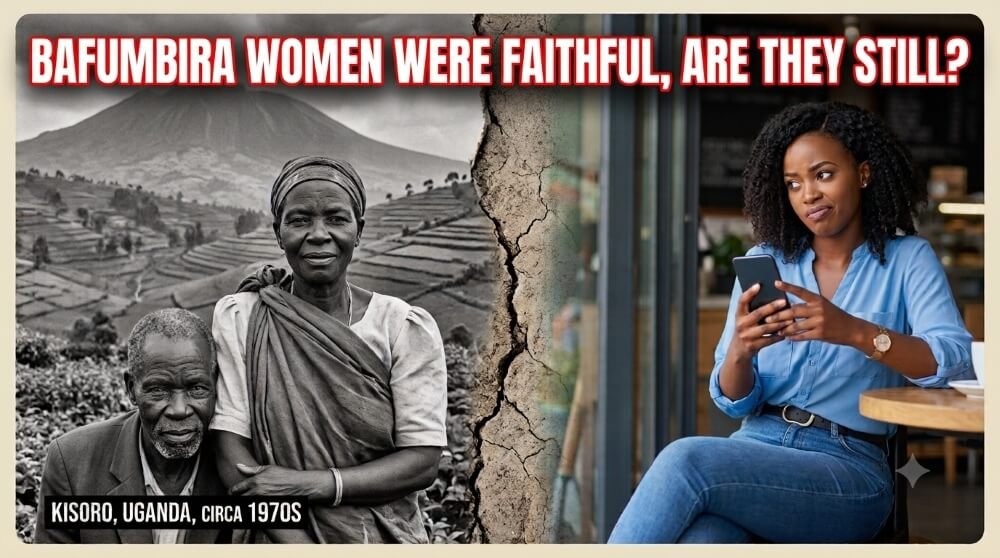
Back in the villages of Kisoro, young Bafumbira women or wives were left behind to navigate complete silence. Yet, oral histories and regional sociological studies consistently paint a picture of extraordinary marital faithfulness among these women. They did not just wait; they managed the entire fabric of society (Tumwine, 2015). They tilled the rocky hillsides, raised children who barely knew their fathers, protected the family’s ancestral land from encroachment, and guarded their marital vows with fierce dignity.
My mother is one of those Bafumbira Women who faithfully waited for their husbands for decades. My mother, Nyirakubanza Josephine, waited for my father, Nsabimana Boniface, for more than 8 years. When Dad finally returned home, we were all there, fresh and ready to welcome him. Since then, my parents are still thriving together. 8 years of waiting!
At times, I hear and remember, my father would send a letter to mom and mom would respond with another, mostly asking him why he was delaying that much and why he was not sending the money and support he promised he was looking for! However, I surely do not remember the responses! Hahahahaha. All I remember is my mom, playing both a man and a woman – doing everything for us to live. Very heroic.
What made the Bafumbira WOMEN to wait?
Bafumbira Women faithfully waited for their husbands because of many reasons, all entagled within Bafumbira Culture and Heritage. In general, Bafumbira valued chastity and humility. Women were historically raised to be completely humble and obedient to their husbands, which extended to upholding moral values in the matrimonial home (Africa 101 Tribe Last Tribes, 2026). Virginity was of value and marriage outside marriage unspeakable. Bafumbira Women were Christians, even without proclaiming that exact faith!
Fear of or respect for communal accountability. For example, in traditional African society, marital fidelity was closely tied to communal accountability and the concept of Inkwano (dowry) or bride price, which legally and spiritually bound families together (Kanyamachumbi, 1992). For Bafumbira women, a woman breaking her vow during her husband’s absence was not just a personal failing—it was a communal shame that dishonored her entire lineage. This deep-seated cultural integrity kept households intact across decades of physical separation.
Thirdly, marriage was not a one-man’s endeavor. For example, marriage involved clans, relatives, and elders, making it more a social achievement rather than personal. As such, a married woman was often expected to uphold the honour of both her husband’s family and her own, making marital commitment a deeply valued virtue (Murdock, 1959; Radcliffe-Brown & Forde, 1950).
Faithfulness was also influenced by the realities of rural life. Divorce carried significant social consequences, and economic opportunities for women were limited. Community life was closely knit, meaning behaviour was highly visible and social expectations were strongly enforced. Adultery was highly condemned. In traditional Bafumbira society, bringing shame upon the husband’s lineage through unfaithfulness could lead to severe consequences, including ex-communication or the family returning the woman to her parents.
These cultural and social structures encouraged marital stability, although they could also make it difficult for individuals to leave unhappy or abusive marriages. Even today, we still suffer some consequences for fear of ‘what will they say or think of me if I do this or that?‘. This was worse in the past!
Community and Kinship Support: Among the Bafumbira, women traditionally marry into the husband’s family homestead. When the husband is away, the wife is not truly “alone”; she lives within the extended family structure, which naturally monitors and supports her. Concerning this, I would want to say that my mom and the children were truly living alone in a lonely homestead. Yes, we were many children and probably provided social life for each other. However, in general, I surely cannot tell how my mother made it!
How about husbands, the Bafumbira Men?
The question of men’s faithfulness is more complicated. While many husbands undoubtedly remained loyal despite long separations, historical studies of labour migration in East Africa suggest that prolonged absence often led some men to establish secondary relationships in towns where they worked (Gugler, 1971; Caldwell, 1982). Some scholars have even argued that some men brought HIV to their village wives when they returned (Moore et al., 2021)
Because society traditionally judged men and women differently, men’s infidelity was often overlooked or tolerated, whereas women faced much harsher criticism. This double standard may explain why stories celebrating women’s faithfulness are more common than stories examining men’s conduct.
On this, it is important to remember that polygamy was acceptable among Bafumbira and many other cultures across Africa. While, by definition, polygamy is different from simply sleeping with another woman, on a whole, when it is acceptable, it makes the casual cheating or sleeping with another woman much easier. And acceptable too.
Wait! Did you know that a big chunk of women agree that it is okay for their men or husbands to have other women? It is a by-the-way, but, yeah, see for yourself here.
Back to the point, I explored the issue of men’s faithfulness when they are away for work, and landed on a few social discussions about the topic and they both suggest that, yeah, on a whole, yes (see here and here). But it is not or should not be expected of all men. Most are or were probably faithful too.
Scholars in Uganda (among the Bafumbira), Nigeria, and in Kenya have consistently showed that most men keep social ties with their original villages and the stronger the ties, the better these men are likely to perform in cities where they went for employment or other opportunities. What is your say?
Bafumbira Women, Faithfulness in Marriage Today
Today, Bafumbira society has changed significantly. Education has expanded opportunities for both women and men. Urbanization has increased migration, while mobile phones and social media allow couples to communicate instantly regardless of distance. Women participate more actively in higher education, business, and formal employment than previous generations. At the same time, modern relationships face new pressures, including financial stress, changing gender roles, social media influences, and greater individual independence.
These changes do not necessarily mean that Bafumbira Women today are less faithful. Rather, relationships now exist in a very different social environment. Trust must be maintained despite constant digital communication, wider social networks, and changing expectations about marriage and personal fulfilment. Faithfulness today depends less on community surveillance and accountability and more on personal values, mutual respect, communication, and shared commitment.
And remember this, faithfulness did not mean happiness!
It is also important to avoid romanticizing the past. While many Bafumbira couples demonstrated extraordinary dedication to one another, not every marriage was happy, and not every husband or wife remained faithful. As we have already noted, faithfulness was sometimes forced by the social structures and culture, but not out of will. As such, it is critical to know that faithfulness does not happen in the empty – right conditions must prevail for one to really the best out of their partner.
Ultimately, faithfulness is not determined by tribe, gender, or generation. It is a personal decision shaped by character, values, love, and commitment. The experiences of earlier generations remind us that enduring relationships require patience, sacrifice, and trust. Modern couples can still learn from these virtues while embracing healthier communication, equality, and mutual respect.
Rather than asking whether Bafumbira women or men were “better” in the past, perhaps the more important question is this: What qualities from our cultural heritage can help us build stronger and more faithful marriages today?




Hi bafumbira , I am glad to join Bafumbira beza
@Muzigaaba you are welcome Ninsiima. We are happy to have you around
hi bafumbira am happy to be hear
@Jbuk we are also happy to have you. Welcome to Bafumbira Beza