

How Bafumbira Clans Got Formed: The Four Pathways According to Nsanzabera Jean de Dieu!

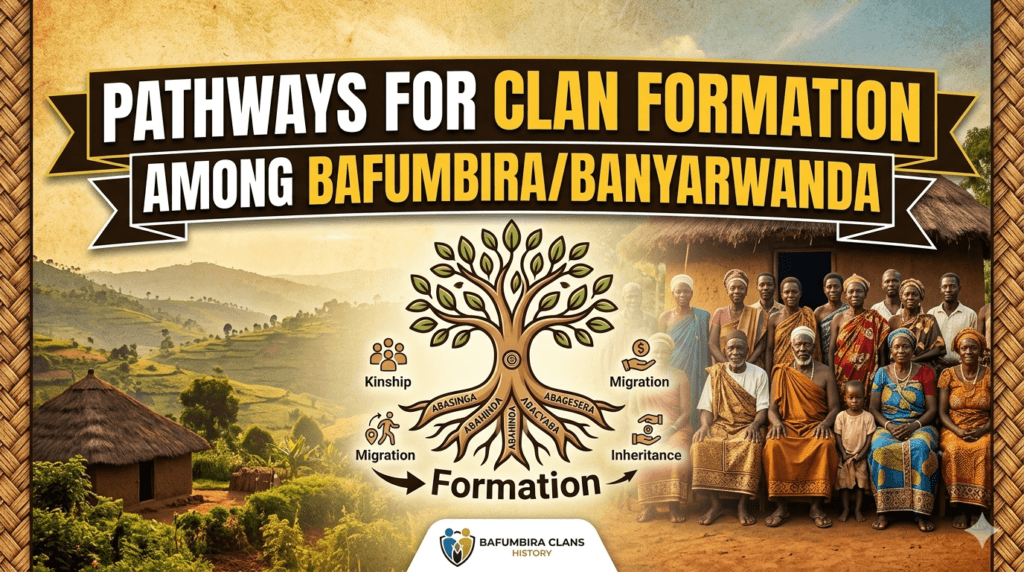
When we count the major Bafumbira clans (Imiryango) or clans of indigenous Banyarwanda, we usually list about 26 main names. But if you look beneath the surface at the complex network of sub-clans (inzu), there are close to 200 distinct lineages! This raises a fascinating historical mystery: How did these clans actually come to be? At what point in history did a family or community realize it was time to branch off and establish a completely new lineage?
In his groundbreaking book, Iyororoka ry’Abanyarwanda, inkomoko y’imiryango migari (The Proliferation of Rwandans: The Origin of Major Clans), the historian and poet Nsanzabera Jean de Dieu provides a comprehensive look at how these identities were forged.
While his work focuses on the roots of the Rwandan people, its relevance extends directly to the Bafumbira of present-day Uganda since we already established that Bafumbira and Banyarwanda share a similar heritage. Before the international borders were demarcated between 1910 and 1912, the regions inhabited by the Bafumbira were intrinsically linked to the same social hubs and clan lineages that built the Rwandan state.
As such, this article is actually about how the Bafumbira Clans were formed.
According to Nsanzabera, the formation of these clans was not a random occurrence but a deliberate process based on human values, competition, and nation-building. He identifies four distinct pathways through which these clans emerged.
Bafumbira Clans Formation: The four pathways!
1. The Pathway of Heroic Deeds
The first and perhaps most prominent pathway is rooted in the actions of exceptional individuals. Nsanzabera explains that many major clans were born from the lineage of a founding hero who performed “extraordinary deeds” in the project of building the nation.
These heroes became so famous through their contributions—whether in military conquest, diplomacy, or social organization—that their names became legendary. To honor this greatness and preserve their prestige, the descendants of these heroes adopted the ancestor’s name as their collective identity.
This process transformed a single family into a major clan, ensuring that the hero’s legacy lived on through generations of people who claimed his name as their own.
Maybe we can start ABANEMEYE clan so we carry forward my legacy!
2. The Pathway of Ancestral Legacy (Umurage)
A second, more spiritual pathway involves the concept of inheritance or legacy (umurage). Nsanzabera describes clans that originated from a specific “will” or set of values bequeathed by the ancestors (ba Sekuruza) to their descendants. This was not merely an inheritance of property, but an inheritance of purpose.
As the descendants actively remembered and honored this heritage, they frequently spoke of the specific ancestor who had entrusted them with this legacy (uwawubaraze).
Through this constant cultural recognition and “active remembrance,” the name of that specific forefather eventually resurfaced as the permanent name for the entire major clan, serving as a “brand” for the family’s character and history.
3. The Pathway of Territorial Founding (Gukonda)
The third pathway is tied to the land and the physical act of establishing a home. Historically, groups of people would identify a piece of original, unclaimed land and “clear” it (gukonda) to establish a territory or a small country. This process of ihangwa ry’ibihugu (the founding of countries) required a unified vision.
The name given to the newly settled land often reflected the specific goals or “missions” the founders had set for their community. Over time, the people who inhabited and protected that land became identified by the name of the country they had founded, which eventually evolved into a clan name.
This explains why many clan names in the region are closely linked to specific geographic heartlands.
4. The Pathway of Functional Responsibilities (Inshingano)
The final pathway relates to specialized roles or duties within the broader project of nation-building. Nsanzabera notes that as the society became more organized, specific groups were assigned distinct responsibilities—such as ritual duties, craftsmanship, or administrative roles—to serve the common good.
These functional groups operated as “teams” or “collectives” working toward a shared goal (icyate). As these groups grew and specialized over centuries, they began to view themselves as a distinct lineage centered around the ancestor who first held those specific responsibilities. Their shared duty became the foundation of their clan identity.
Conclusion: A Shared Regional Heritage
The significance of these four pathways is visible in the list of clans shared by the Bafumbira and Rwandans today, such as the Abasinga, Abazigaba, Abanyiginya, Abagesera, and Abasindi. Nsanzabera reminds us that all 26 major clans of the region originate from three primary “hubs”: the Abasinga, Abazigaba, and Abanyiginya.
When the colonial borders were set in 1912, groups like the Abahinda were separated into Uganda (specifically Ankole and Bufumbira), while others like the Abahunde and Abashi remained in the DRC. However, the “roots” of these clans remain the same.
Whether through the deeds of a hero, the legacy of a will (umurage), the clearing of land (gukonda), or the fulfillment of a national duty, the clans of the Bafumbira were formed through a sophisticated process of social engineering that continues to define their identity today.
So tell us; how do you think your clan came about?
Responses